Business Model
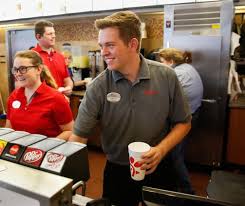
Chick-fil-A’s business strategy involves a focus on a simple menu and great customer service. While other fast-food chains often expand their menu offerings to attempt to attract new customers, Chick-fil-A’s business model is to remain focused on chicken sandwiches. The capital “A” in “Chick-fil-A” is meant to represent that their chicken is of grade A top quality. An emphasis on customer service has also allowed the company to consistently lead the fast food industry in customer satisfaction. In a later post, I will go further in-depth about this as well as its impacts on popular culture and social media.
Corporate Culture
S. Truett Cathy was a devout Southern Baptist and his religious beliefs had a large impact on the company. The company’s official statement of purpose says that the business exists “To glorify God by being a faithful steward of all that is entrusted to us. To have a positive influence on all who come in contact with Chick-fil-A.”
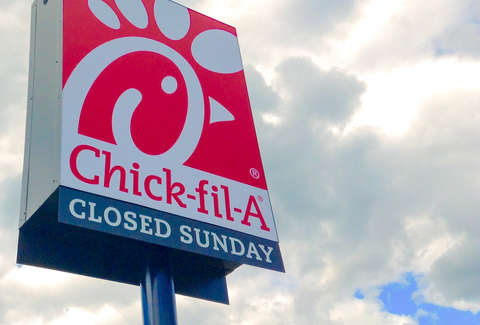
The founder’s beliefs are responsible for the chain’s most well-known and distinctive feature: all Chick-fil-A locations are closed on Sundays, as well as on Thanksgiving and Christmas. S. Truett Cathy states as the final step in his Five-Step recipe for Business Success: “I was not so committed to financial success that I was willing to abandon my principles and priorities. One of the most visible examples of this is our decision to close on Sunday. Our decision to close on Sunday was our way of honoring God and of directing our attention to things that mattered more than our business”.
The company is very strict on this matter, where their Sunday closures extend to non-traditional locations. In addition to the many shopping malls and airports, a Chick-fil-A location at Mercedes-Benz Stadium is closed on Sundays despite the fact that the stadium’s main host, the Atlanta Falcons, plays most of their home games on Sundays.

 Chick-Fil-A: The Epitome of American Exceptionalism